This guide explains how to use an Ageism Questionnaire to measure workplace and service-related age bias with consistency and ethical care. It provides objective background on ageism, why structured assessment matters, and how organizations can translate results into fair improvement plans. You’ll also find evaluation conditions, a practical comparison of approaches, and FAQs for common implementation questions.
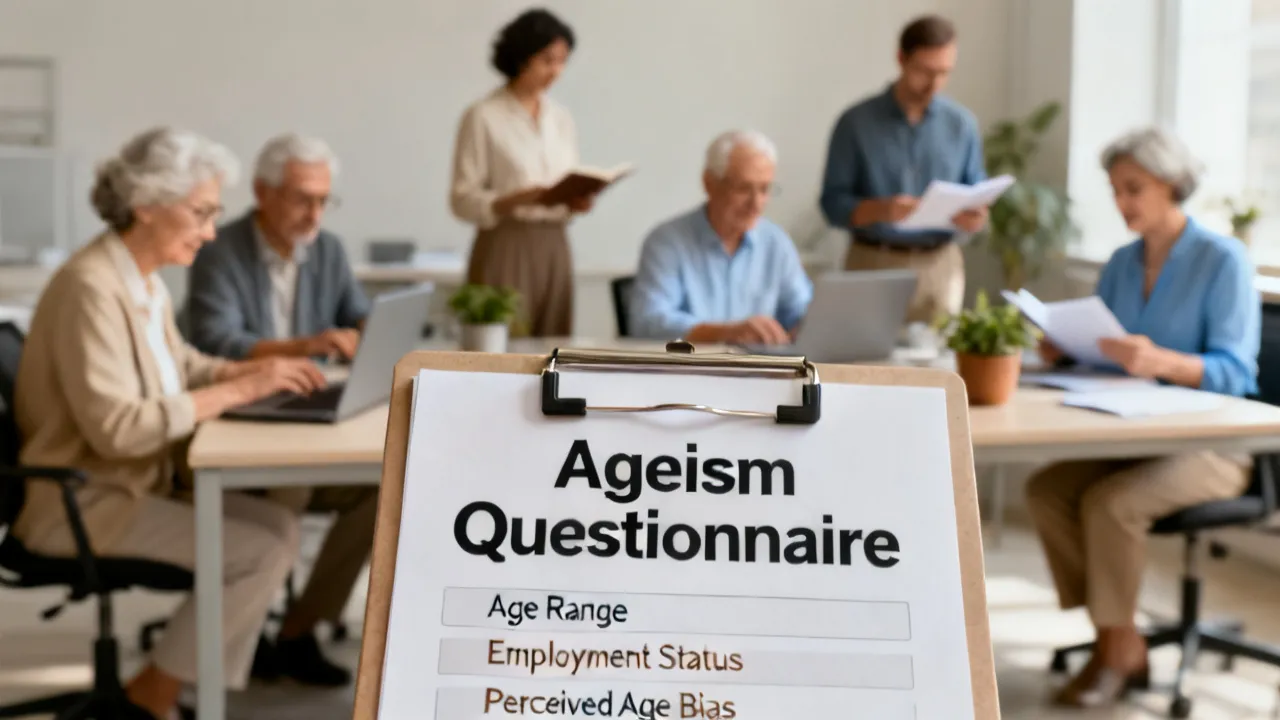
An Ageism Questionnaire is a structured assessment tool designed to identify, quantify, and understand age-related bias in environments such as workplaces, healthcare settings, and customer-facing services. Used well, it supports more consistent observation than ad-hoc complaints, and it gives decision-makers a defensible basis for training, process redesign, and policy updates.
When organizations rely only on informal feedback, leaders often end up with an incomplete picture: bias may surface only when someone feels bold enough to report it, only when a particular incident becomes memorable, or only when a certain type of employee (for example, more senior, more confident, or more protected) speaks up. An Ageism Questionnaire changes that dynamic. It creates a repeatable method for collecting comparable signals across time, roles, departments, and locations.
At its best, an Ageism Questionnaire helps you do several things at once:
In practical terms, the questionnaire functions like a “measurement layer” over an organization’s lived experiences. Instead of debating whether ageism “feels” present, you can examine which items show the strongest negative experiences and which groups report the greatest friction. Then—crucially—you can connect those findings to process changes and remeasurement.
This means an Ageism Questionnaire is not simply a compliance document. It is an operational instrument: it should help you decide what to fix, where to fix it, and how to confirm that the fix worked.
Ageism can appear through “small” behaviors—how people are addressed, how opportunities are offered, how competence is assumed, and how communication is adapted. Because these signals are frequently subtle, many organizations rely on narratives that vary by role, department, or personal experience. An Ageism Questionnaire standardizes questions so that responses can be compared over time and across groups, helping you move from perception to pattern recognition.
Age bias is often embedded in ordinary routines. Consider a few common examples across workplace and service contexts:
These behaviors can be difficult to measure because they do not always present as overt statements. Instead, they show up as consistent differences in how people are treated, how much patience they receive, or how often their competence is challenged. People may experience the bias but not label it as ageism, especially if it is delivered politely or framed as “just how things are done.”
An Ageism Questionnaire helps by focusing on observable experience and perception of fairness across structured dimensions. Rather than relying on the respondent to guess whether a particular event “counts” as ageism, the questionnaire prompts them to evaluate everyday interactions and decision points. This reduces ambiguity and increases the likelihood that the collected data reflects real patterns.
Another reason this matters now is that many organizations are going through workforce and demographic changes. Longer careers, later retirements, and a broader age range within teams can increase the chance that age stereotypes will be activated—especially in mixed-age groups where communication styles and expectations differ. When teams diversify in age, managers and systems must adapt too. An Ageism Questionnaire becomes a proactive tool to monitor whether those adaptations are happening.
Finally, many organizations have discovered that bias is not evenly distributed. Even if a department believes it is fair, the questionnaire might reveal that certain roles, shift schedules, or client types experience more negative treatment. Without a structured assessment, those uneven patterns can remain invisible until they become a reputational issue or a litigation risk.
From an industry expert’s perspective, the primary risk is not asking questions—it’s using the results poorly. A well-designed Ageism Questionnaire should be:
“Quality” in this context means more than reliability (that the survey results are stable). It includes validity (that the survey actually measures what it claims to measure) and fairness (that respondents across age ranges interpret items similarly).
To think about validity, it helps to ask: do these questions capture age-related experiences specifically, or are they mixing age with other factors like tenure, job function, or career stage? In a well-constructed questionnaire, items are designed so they are sensitive to age-based assumptions without being overly dependent on tenure. For example, an item about respect in communication can reflect age bias whether the respondent has been employed for two years or thirty years. At the same time, scoring and interpretation should acknowledge the overlap between age and experience level (because people’s expectations about feedback may differ by career stage).
To think about fairness, the questionnaire should avoid vocabulary that could be read as “youth-biased” or “elder-biased.” If a question references technology in a way that implies older employees are less competent, older respondents may feel defensive or may interpret “agreement” differently than younger respondents. Similarly, if items emphasize “keeping up” with change as the only marker of competence, they may inadvertently equate age with learning speed, embedding stereotypes into the measurement itself. Fair questionnaires use neutral phrasing and consistent response scales.
To think about ethical administration, quality includes how the survey is introduced and managed. If employees suspect that individual responses will be tracked by manager, honest responses may drop. If participation feels unsafe or pointless (“They won’t do anything”), response fatigue may rise. Ethical administration protects respondents by reducing fear, clarifying confidentiality, and demonstrating follow-through.
To think about alignment to action, you should treat the questionnaire like an input to a system improvement process. If the organization cannot act on the findings—because the relevant decision makers don’t have control over hiring or training policies—then the questionnaire may create distrust. A high-quality approach ensures there is at least a plausible chain of responsibility: the findings will inform specific decisions within a defined timeframe.
If you only have time for a short rollout, focus on these essentials:
There is a tendency in many organizations to jump straight to “launch” because time is limited or because stakeholders want quick visibility. But in bias measurement, small mistakes can cause large damage. If items are confusing or if respondents believe results will be used against them, the data may become both inaccurate and politically risky. Piloting and communication are therefore high-impact: they preserve data quality and trust.
Another high-impact step is deciding how you will act. Even a short rollout can be effective if the organization can say: “These are the three decisions we will improve based on survey findings.” Without a visible action plan, a questionnaire becomes a conversation without outcomes.
Finally, segment analysis is crucial. Ageism might not show uniformly across an organization. If leadership only reads an overall average score, they may miss the most urgent issues. Segment analysis should be paired with privacy protections so that smaller groups remain anonymous in reports.
Organizations typically get more reliable insight when questionnaires are treated as part of a governance system—paired with training, leadership accountability, and operational follow-through. In many jurisdictions, employers and public bodies also have legal obligations to prevent discrimination and ensure equal access. While rules vary, the underlying expectation is consistent: you should be able to demonstrate that you have evaluated risk and taken reasonable steps to mitigate it.
For background, the topic of age-related bias is widely discussed in research and policy materials. The World Health Organization (WHO) describes ageism as a social problem that can lead to discrimination and unequal treatment in multiple domains (see WHO “Ageism” resources). The U.S. Equal Employment Opportunity Commission (EEOC) addresses workplace discrimination under age-related protections and encourages organizations to prevent discriminatory practices. These sources support the rationale for measuring bias signals early rather than relying solely on complaints.
Good practice in many organizations tends to share several characteristics:
There is also an important philosophical aspect: good practice recognizes that ageism can harm people even when no one intends harm. A questionnaire should therefore be used to strengthen systems, not to hunt for individual villains. This orientation reduces defensiveness and improves the chances that improvements will be adopted.
In a litigation or compliance context, structured measurement can also help demonstrate that the organization acted reasonably. While specific legal thresholds vary, documenting risk assessment steps and improvement actions can be valuable. That said, the best reason to run an Ageism Questionnaire is not legal; it is operational and human. It improves how people experience daily work and service interactions.
Rather than copying a generic form, treat your questionnaire as a measurement instrument tied to your environment. Common categories include:
When drafting items, an expert approach is to phrase statements neutrally (e.g., “In my environment, people are valued for their contributions regardless of age.”) and use consistent response options. This reduces measurement error compared with mixing different styles of questions.
To make the questionnaire more informative (and less generic), it helps to translate each category into “decision points” or “interaction points.” For example:
Another useful addition is to include a small number of items that capture “agency”—whether respondents feel they can ask questions, request accommodations, or clarify expectations without negative consequences. While not always labeled “ageism,” lack of agency can manifest as age bias: people might feel they cannot speak up because they are presumed to be “less assertive” or “less capable of handling complex explanations.”
Finally, consider whether your environment includes customers or patients. In service contexts, add items relevant to treatment thoroughness, respect in interactions, explanation quality, and perceived responsiveness. For healthcare, for example, you might ask whether clinicians explain options in ways that match the patient’s needs and whether symptoms are taken seriously regardless of age. For customer service, you might ask whether agents provide the same quality of help and whether staff adjust assumptions about problem complexity based on the customer’s perceived age.
The key is to design items that can lead to action. If an item is too vague (“I experience unfair treatment”), it may be harder to decide what to change. If items are specific enough to reflect interaction patterns, you can connect them to training content and process revisions.
Quantitative summaries can be useful, but interpretation should be cautious. A questionnaire often measures perceptions and experiences, not direct intent. Therefore, scores are top treated as indicators to investigate, not as final proof of wrongdoing.
Practical guidance:
Overconfidence is a common error in survey programs: leaders treat a high score as proof that no bias exists, or a low score as proof that discrimination has occurred. Because the questionnaire measures perceptions, it can show where the experience is negative, but it does not prove intent or legal elements. People may perceive age bias for reasons unrelated to age (e.g., leadership style, workload, communication training gaps). This does not make the perceptions unimportant—it means they require careful investigation.
A strong interpretation approach looks like this:
It’s also important to address response distribution and sample size. If a small segment receives only a few responses, the organization should apply caution. Many programs implement reporting thresholds (e.g., do not publish results for groups below a certain response count). This protects anonymity and prevents unreliable conclusions from being presented as evidence.
Finally, consider the possibility of “response style bias.” Different age groups might respond differently to rating scales (some are more likely to select neutral; some are more direct). This is not a reason to abandon the survey, but it is a reason to analyze patterns thoughtfully and, where feasible, use psychometrically informed methods.
For results to be credible, you should meet operational conditions before rollout and during analysis. Consider the following requirements as governance checkpoints.
| Approach | When it fits top | Key conditions/requirements | Typical outputs |
|---|---|---|---|
| Pilot-first rollout | New questionnaire deployment or new policy context | Clear purpose statement; small sample pilot; comprehension checks; revisions before full launch | Refined wording; reliable response distribution; improved item clarity |
| Annual/biannual measurement cycle | Ongoing risk management and continuous improvement | Consistent questionnaire version or documented changes; stable administration window; follow-up action plan | Trends over time; evidence for training and policy effectiveness |
| Targeted pulse survey | After major HR or service process changes | Short survey length; clear timeframe; communication that results feed into process review | Immediate signals; prioritized areas for intervention |
| Mixed-methods validation | High-stakes decisions (e.g., redesigning promotion systems) | Structured follow-up interviews; careful coding; avoid leading interview questions | Explanation of quantitative patterns; stronger internal validity |
Beyond these approaches, credible results also require competent administration. For example, the survey must be accessible to different populations: people with different levels of digital comfort should still be able to complete it. If the questionnaire is only available in one digital format, some respondents may be excluded unintentionally—creating a skew that might be mistaken for bias. Accessibility and usability checks are therefore part of credibility.
It also helps to ensure that the administration timing does not coincide with unusual organizational stress (e.g., a restructure that could temporarily reduce perceived fairness). While stress events can be relevant data, they should be recognized in interpretation. A good practice is to document the context around the survey: what major changes occurred, whether leadership transitions occurred, and whether any policy changes were introduced around the same time.
The steps below present a practical sequence that many organizations adopt to reduce measurement bias and improve actionability.
To strengthen these steps, consider additional practical details that often determine whether a program succeeds:
A common failure mode is to treat the questionnaire as a standalone initiative. A better approach treats it as the “measurement half” of a loop. The organization must commit to the “improvement half”: training sessions, changes to evaluation rubrics, redesign of mentoring access, adjustment to communication guidance, and revision of service protocols.
Another failure mode is misalignment between the questions and the organization’s ability to act. If you ask detailed questions about promotion fairness but promotion decisions are controlled externally, you may frustrate respondents. In such cases, adapt the scope to match control: you can still measure perceived fairness, but you should interpret results as guidance for local levers (e.g., feedback quality, preparation sessions, internal mentoring access).
Finally, to improve engagement, organizations should communicate results in a respectful way. Even if you cannot share all details, share at least the categories where signals were found and the actions you will take. Silence after participation erodes trust quickly.
In practice, organizations often purchase or adapt assessment tools from vendors (“suppliers”) or build internal questionnaires. Because pricing varies by scope (sample size, analytics, language versions, and support), it is better to evaluate suppliers using a structured vendor due-diligence checklist rather than relying on generic price claims.
How to request pricing information effectively:
If you already have a supplier, you can evaluate whether their offered Ageism Questionnaire aligns to your objectives by requesting an example report format and the methodology used for analysis and interpretation.
To avoid guesswork, it is useful to treat “cost” as more than dollars. Consider the total cost of ownership across implementation, administration, analysis, action planning, and follow-up. A cheaper questionnaire that produces unclear or non-actionable reporting can end up more expensive in internal time and reputational risk.
When evaluating suppliers, ask whether they can explain the scoring approach in plain language. Even if they use advanced analytics behind the scenes, stakeholders need to understand what a score means, what it does not mean, and how results will be used.
Also evaluate whether the supplier supports ethical administration. For example:
In many organizations, the supplier’s role should not extend to “owning” the action plan. The organization should retain ownership of decisions. The supplier should provide measurement and analysis support, while HR, operations, and leadership teams should own interventions.
Finally, if you operate across multiple locations or languages, ask about localization and translation quality assurance. Poor translation can distort item meaning and reduce validity—especially for questions about respect, communication, and competence assumptions, where wording nuance matters.
Even when the core concept is consistent, how people interpret age-related statements can vary by culture and workplace norms. If you operate in or near a specific city or country, consider local communication styles and expectations about discussing bias. For instance, in some environments respondents may be reluctant to express disagreement directly, while in others they may interpret certain phrasing as impolite rather than bias-related.
Because your provided instructions include replacing any explicit city/country keyword placeholders with “nearby,” treat localization as a principle rather than a fixed label: test wording with a small local group during the pilot stage to confirm meaning and clarity.
Localization is not only about language translation. It includes cultural expectations around:
Because these differences can influence measurement, a high-quality approach includes a pilot in the local context and, where possible, follow-up interviews to clarify how respondents interpret each item.
Localization also means you may need to adapt response anchors. For example, if a response option uses a phrase like “strongly agree,” ensure that the equivalent phrase is used consistently and that it reflects a similar intensity across languages.
In a multi-region organization, consider running parallel pilots in different cultural contexts. The goal is not to dilute the concept of ageism but to ensure that the instrument measures the intended construct consistently.
Below are additional pitfalls that frequently emerge in real-world implementations, along with practical ways to mitigate them.
Pitfall: Asking what you can’t act on—If the questionnaire reveals fairness problems but the organization cannot influence recruitment, pay, or promotion rules, respondents may feel betrayed. Mitigation: tailor the questionnaire to the decisions you can influence, and interpret findings accordingly.
Pitfall: Ignoring the difference between experience and intent—Some organizations respond to low scores with “bias training” alone, without addressing the operational causes of the negative experiences. Mitigation: combine measurement with process review. If respect and communication are low, improve manager coaching and feedback norms. If opportunity access is low, examine who gets considered for roles and why.
Pitfall: Treating the questionnaire as the end—A questionnaire is only one step. Mitigation: formalize an action-planning process, assign owners, track deliverables, and remeasure.
Pitfall: Poor communication—If respondents are unclear about confidentiality or timelines, trust declines. Mitigation: communicate purpose, confidentiality, and next steps. Provide a clear channel for urgent safety issues separate from survey feedback.
Pitfall: Survey fatigue—If you administer too often or ask too many items, response rates fall and data quality decreases. Mitigation: use a stable core set of items and add modules only when necessary. Use pulse surveys after major changes, not continuously.
Pitfall: Misinterpreting “neutral” responses—Neutral may mean “no experience,” “uncertain,” or “no opinion,” not necessarily “agreement.” Mitigation: interpret item distributions, not only averages, and consider qualitative follow-up.
Pitfall: Under-using qualitative data—Open-text comments and listening sessions often explain how respondents interpret bias. Mitigation: code qualitative data systematically and use it to refine the action plan.
A credible Ageism Questionnaire program includes ethics as a measurable constraint. From an expert standpoint, this means:
Ethics in questionnaire administration is not merely a moral principle; it is essential to data quality. If confidentiality is unclear or if respondents fear retaliation, the survey may attract only certain voices. That can lead to both measurement bias and moral harm.
Consider designing the communication plan with ethical clarity:
Data minimization is also crucial. You should collect only the data needed to segment results appropriately. If the objective is to examine age-related bias experiences, you may need age group categories, but you may not need personally identifiable information. If the survey is administered in a way that associates responses with specific individuals, anonymization becomes harder and ethical risk increases.
Responsible reporting means aggregating results and using thresholds. If a small group receives too few responses, publishing their results can inadvertently identify them. Instead, use a threshold system, combine groups where appropriate, and provide category-level findings rather than individual-level data.
Ethical administration also includes accessibility. If older respondents struggle with the survey format due to font size, digital complexity, or language barriers, the tool fails fairness. Ethical administration therefore includes design choices that support equal access.
When organizations frame an Ageism Questionnaire program, it helps to cite established references. Relevant starting points include:
These sources support the rationale for measuring bias signals while emphasizing prevention, fair processes, and continuous improvement rather than punitive responses based on survey results alone.
In addition to general references, good practice also involves grounding the questionnaire in measurement principles. While the specific psychometric methods may vary, many programs benefit from basic quality checks such as:
When the questionnaire is deployed in high-stakes settings (for example, where results could influence major restructuring), it is especially helpful to use a mixed-methods approach and consider more advanced validation strategies.
Importantly, evidence-based framing also supports transparency. When leadership communicates why the questionnaire is being used, linking it to established references can increase legitimacy and reduce skepticism. That credibility can improve participation rates and reduce fear about the survey’s purpose.
An Ageism Questionnaire is a structured set of items that captures perceptions and experiences related to age-related bias—such as respect, inclusion, opportunity fairness, and competence assumptions—within a defined setting.
Depending on your context, the questionnaire can be adapted for workplace environments (manager interactions, HR processes, training access), healthcare settings (communication clarity, seriousness of assessment, respect in explanations), and customer service (responsiveness, explanation quality, equitable access to help).
Use clear instructions and consistent response scales, protect confidentiality, and communicate how results will be used for improvement. Piloting helps ensure items are understood the same way across groups.
Additional administration best practices include ensuring the survey is accessible (font sizes, language clarity, multiple completion options), avoiding leading statements, and using reminders that do not pressure participation.
No. They typically measure perceptions and reported experiences, which are important indicators but not direct proof of intent. Use them to identify patterns and guide investigation and process changes.
However, perceptions can still be meaningful. Negative experiences, even when intent is unclear, can be harmful and can justify improvements to communication norms, evaluation rubrics, and service protocols. The questionnaire is designed to trigger investigation, not to make final legal determinations.
Common practice is to use a periodic cycle (such as annual or biannual) for trend monitoring, and optionally add pulse surveys after major policy or organizational changes. The correct frequency depends on risk exposure and change events.
If your organization is undergoing major restructuring, expanding into new markets, or changing training systems, more frequent pulse measurement can help identify whether changes improve experiences or unintentionally create new friction.
Create an action plan with clear owners and timelines, conduct targeted listening sessions to understand contributing factors, update relevant processes (e.g., training access, evaluation criteria, mentoring structures), and remeasure after implementation.
To improve effectiveness, focus interventions on the most actionable signals. If respect and communication show the strongest issue, prioritize manager training and coaching. If opportunity fairness is the strongest signal, audit who is offered roles, training, or sponsorship and revise selection processes.
In very responsible programs, individual responses are kept confidential and not shared with managers. Reporting should be aggregated to protect anonymity and encourage honest participation.
Where there are exceptional circumstances (such as a serious safety incident), there should be a separate reporting pathway that follows organizational policy and legal requirements. The questionnaire itself should not become a channel for individual-level accountability without strong ethical and procedural safeguards.
Suppliers may provide questionnaire templates, analytics, reporting dashboards, translation, and implementation support. Verify methodology details (scoring approach, privacy handling, and quality checks), and request sample reports before signing.
Also verify that the supplier’s approach includes ethical administration guidance, accessibility considerations, and options for localization and pilot testing. Ask how they help you interpret results responsibly, including cautions about perception-based measurement.
It’s strongly recommended if you operate across cultures or distinct communication norms. At minimum, conduct a pilot in the local context to confirm that items are interpreted as intended.
Localization is also valuable when different groups within the same country have different communication norms (for example, corporate vs. frontline settings). Piloting can reveal misunderstanding or differences in how certain statements are read.
Track movement on the same questionnaire items over time, plus leading indicators tied to the action plan (for example, training completion, policy usage, and documented process improvements), and consider qualitative feedback to interpret changes.
Examples of leading indicators include audit metrics (e.g., distribution of mentorship offers by age group, access to high-visibility assignments), process compliance (e.g., consistent interview rubric usage), and training implementation metrics (e.g., manager coaching sessions completed and reinforced).
An effective Ageism Questionnaire is more than a form—it is a measurement and governance mechanism. When you prioritize ethical administration, consistent scoring, and credible follow-through, the questionnaire becomes a practical tool for reducing age-related friction and improving fairness in everyday decisions.
When organizations treat the questionnaire as part of a continuous improvement loop—listen, analyze, act, remeasure—they build a culture where people are valued across age. The long-term benefits go beyond survey scores: improved communication, more equitable opportunity pathways, better service experiences, and greater trust in organizational decision-making.
In that sense, the questionnaire is not simply about identifying bias. It is about strengthening systems so that dignity and competence are recognized fairly—every day, in the routines where bias can otherwise persist unnoticed.
Using an Ageism Questionnaire for Fair Workplace Practices

Using an Ageism Questionnaire for Fair Workplace Decisions

Using an Ageism Questionnaire for Workplace Fairness

Using an Ageism Questionnaire for Fairer Workplaces

Using an Ageism Questionnaire for Fairer Workplaces

How an Ageism Questionnaire Supports Workplace Fairness
Practical Use of an Ageism Questionnaire in Organizations

Using an Ageism Questionnaire for Fair Workplace Culture

Using an Ageism Questionnaire for Fairer Workplaces

How to Use an Ageism Questionnaire Effectively
This guide explains how to use an Ageism Questionnaire to measure workplace and service-related age bias with consistency and ethical care. It provides objective background on ageism, why structured assessment matters, and how organizations can translate results into fair improvement plans. You’ll also find evaluation conditions, a practical comparison of approaches, and FAQs for common implementation questions.

Rose Rocket: Industry Guidance on Selection and Use
This guide explains how to evaluate a Rose Rocket product from supplier and safety standpoints, from materials and intended use to purchase verification. Objectively, “Rose Rocket” is a branded product name associated with rose-themed rocket-style novelty items or décor. The article outlines practical selection criteria, quality signals, and responsible handling based on common industry practice.

Exploring the Impact of Foundations U
Foundations U is a pivotal educational initiative designed to enhance foundational skills among learners. By equipping individuals with essential skills and knowledge, it plays a crucial role in their personal and professional development. This article delves into its structure, objectives, and the transformative effects it has on education.

Understanding Foundations U Essentials
Foundations U serves as a groundbreaking initiative designed to transform educational experiences. By focusing on comprehensive student development programs, it aims to bridge the gap between secondary education and tertiary experiences. This article delves deep into the structure and objectives of Foundations U, providing insights into its innovative approach towards cultivating academic excellence.

Understanding Foundations U
Foundations U is an emerging paradigm within the educational landscape, emphasizing core academic principles while adapting to contemporary challenges. This guide will delve into the significance of Foundations U, exploring its role and impact within modern education. Structured educational practices have continually evolved, driving institutions to adapt and shape students into critical thinkers and informed citizens.

Foundations U: Building Academic Excellence
Foundations U represents a pioneering concept in higher education, focusing on a holistic approach to learning. By integrating comprehensive academic programs, this institution, located in the dynamic setting nearby, aims to foster intellectual growth, practical skills, and global citizenship. It stands as a beacon for students seeking an immersive and transformative educational experience.
